
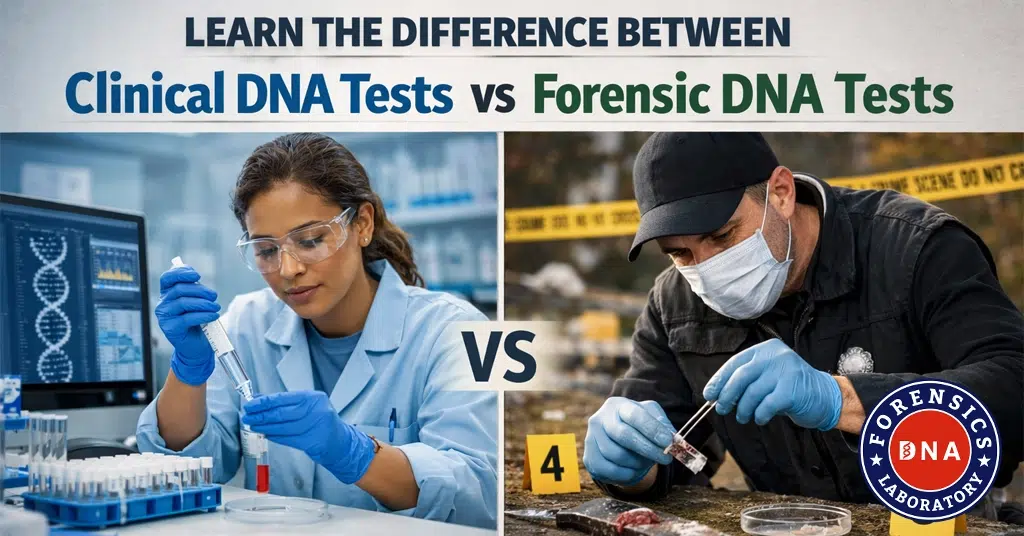
When you begin looking into genetic testing, you might feel overwhelmed by the many options available. You could be searching for answers about your health or trying to solve a legal matter regarding your family. Understanding the primary differences between categories of DNA testing services is the first step toward choosing the right DNA test for your needs.
When you look at a forensic and clinical DNA test, you are looking at two paths that lead to very different use cases, along with their outcomes. One path helps you understand your body’s health, while the other provides genetic proof that stands up in a court of law. Choosing the right one depends entirely on your specific situation and what you plan to do with the information.
About Clinical DNA Test
A clinical DNA test is primarily used for medical diagnosis and health-related genetic tests. These tests examine your genetic code to identify specific changes that might cause or increase the risk of a disease. Doctors often recommend these tests to confirm a diagnosis when a person shows symptoms or to screen for hereditary conditions that run in the family.
By analyzing your DNA markers, lab experts can provide information that helps you and your healthcare provider make better choices for your future treatments.
In addition to medical diagnosis, this category includes Wellness Tests. These tests are designed to help you understand how your body works on a daily basis. For example, they can reveal how you process certain nutrients, your skin’s natural tendencies, or even your ideal fitness routine.
By getting this information, you can take a proactive approach to your health. These tests are all about personal health improvements, providing a roadmap for a healthier lifestyle based on your unique genetic makeup.
About Forensic DNA Tests
Forensic DNA tests are designed for official and legal identification. You often see these used in the news to identify suspects in crimes or to solve cold cases. However, their use goes far beyond criminal investigations.
They are also vital for reuniting lost people with their families by matching their DNA with relatives and for identifying bodies during natural disasters or accidents. In these sensitive situations, accuracy and a strict process are required to ensure the identities are correct beyond any doubt.
Within this forensic test category, you will also find legal DNA tests. These are used for specific cases such as:
- Child Custody: Proving parenthood to settle disputes.
- Inheritance: Establishing a biological link to claim an estate.
- Legal Identity: Verifying relationships for official government records.
Chain of Custody in Forensic Genetic Testing
A chain of custody is a formal way to handle the DNA samples to ensure that no one can tamper with the samples. They’re used for court-related disputes. Also, sometimes, embassies in special cases demand a DNA test under this strict procedure.
In this type of test, an appointed official monitors the whole autosomal DNA testing process. Initially, the official verifies the identities of the individuals involved in the DNA test using their government-issued IDs and passports (in case of immigration).
After identity verification, the DNA sample collection process starts. Moreover, until the samples are securely sealed, the official continues to monitor the process.
Forensic vs Clinical DNA Tests
The choice between a forensic vs clinical DNA test comes down to the intended use of the report. A clinical test is a private health matter between you and your doctor. It focuses on the biology of your health, such as how your cells function and what health risks of genetic disorders you might face. The clinical DNA test results are used solely for medical records and personal wellness.
A forensic test, however, is built for the legal system. The focus is not on your health, but on your identity and your biological relationship with others. The laboratory follows strict legal protocols to ensure the sample is never tampered with and that the person being tested is verified with photo identification.
While both tests use similar methods to look at DNA, the forensic tests are often the only ones that are admissible in legal use cases. If you need a result for an official reason, the forensic path is the only valid choice.
Medical DNA Test vs Forensic
When people discuss a medical DNA test vs forensic testing, it is important to remember that clinical and medical DNA tests are usually the same thing. Both terms refer to testing done for health-related reasons.
Whether a doctor calls it a “medical” screen or a “clinical” diagnosis, the goal remains the focus on your physical well-being. Forensic testing stands apart from both because its goal is legal identification, not health assessment. While medical tests help you live better, forensic tests help you prove your legal rights.
Types of DNA Testing
There are several types of DNA testing available to suit different needs. Each one serves a specific role in either your personal health journey or a legal requirement:
- Paternity & Maternity Testing: Used to prove biological parenthood for peace of mind or legal rights.
- Immigration DNA Testing: Required by embassies to prove family ties for visa applications.
- Genetic Ancestry Testing: Traces your family roots and ethnic origins across thousands of years.
- Prenatal Paternity Testing: Determines the biological father safely during pregnancy.
- Siblingship Testing: Confirms if two individuals share one or both parents.
- Grandparentage Testing: Establishes a link between a child and their grandparents when a parent is unavailable.
- Y-STR and mtDNA Testing: Traces the direct paternal or maternal lineage through generations using Y-chromosome and mitochondrial dna testing.
Understanding the DNA Test Purpose
Every test begins with a clear DNA test purpose. Identifying your goal helps the laboratory provide the correct service. Common purposes include:
- Peace of Mind: Personal curiosity about family relationships or health without the need for legal paperwork.
- Sponsored Immigration: Providing the necessary proof to join family members in another country.
- Legal Disputes: Settling court cases involving child support, custody, or inheritance.
- Ancestry DNA Test: Discovering your heritage and where your ancestors lived.
- Prenatal Paternity: Finding paternity answers early in a pregnancy through a non-invasive process.
Why Choose DNA Forensics Laboratory for Forensic & Clinical DNA Tests?
DNA Forensics Laboratory, also called DFL, is one of the most reliable and trustworthy labs in India for different categories of DNA tests. We hold accreditations from NABL and ISO, demonstrating the highest DNA testing standards of our facilities.
Besides, DFL is the only private DNA testing company in India whose DNA test reports are legally admissible in the honorable courts of law. This makes us an ideal lab for forensic DNA tests that require court-admissible evidence.
Whether you are looking for medical insights or forensic proof, making the right choice between a forensic vs clinical DNA test ensures you get the answers that matter most to your life.
For more information or to book a DNA test, call us at +91 8010177771. Alternatively, you can also send a message on WhatsApp at +91 9266615552.
Frequently Asked Questions
Q1. How long does a forensic DNA test take?
Ans: A forensic DNA test is usually done within 5 minutes, but the sample analysis can take several days, depending on the complexity. The final report is usually sent in 8-10 business days.
Q2. How to order a clinical DNA test online in India?
Ans: Call the experts at DNA Forensics Laboratory and order a DNA sample collection kit. The kit comes with all the necessary prerequisites for a DNA test.
Q3. How accurate are clinical DNA tests offered by Indian labs?
Ans: Clinical DNA test, just like any other DNA test, provides 99.99% accurate information related to genetic markers.
Q4. Can a forensic DNA test identify someone after a disaster?
Ans: Yes. It’s one of the primary use cases of a forensic DNA test. By comparing the DNA of the person in the disaster with that of their family member, lab experts can determine the biological identity.

